The new SSB Short Scale Bass is an instrument design that I've had in my mind for several years. This year, I finally
found the time to get it developed and into limited production. The SSB is now available in fretted and fretless
versions directly from me. I build them in small batches, depending on the demand. Here's the story behind this unusual bass:
The Overall Design:
Short scale basses are generally defined as having scale lengths between 30" and 32". This puts them about halfway
between a conventional 34" "long scale" bass and a typical 25 1/2" scale length guitar. They're usually just four
strings, tuned in the conventional EADG. In the 60's, short scale basses were more popular, but they generally were cheap
student models with narrow string spacing and poor tone. As a result, many bassists got a bad impression of them.
Although many bassists find the closer spacing of the frets more comfortable to play, for various reasons, they
haven't really caught on. With the exceptions of the Ampeg/Dan Armstrong "See-Thru"
basses, the Jerry Jones models and a few special order Alembics, there aren't many good professional-quality short
scale basses on the market today.
Ampeg's original SSB was introduced in '67. There's a page on this site about it here. It
was an interesting idea, but too many of its design features turned off buyers. It was a failure in the marketplace,
and was discontinued after only a month or so of production. I have an original SSB and an SSUB in my collection,
and they're fun to play, with a suprisingly boomy sound. The biggest drawback to them is the narrow string spacing at
the bridge, which is uncomfortable to play finger style. And, like most short scale basses, the strings are kind
of soft and floppy feeling. I've shown them to many of my friends, and they like them, but they're small
enough overall that the general impression is that they're a toy, not a "real" bass.
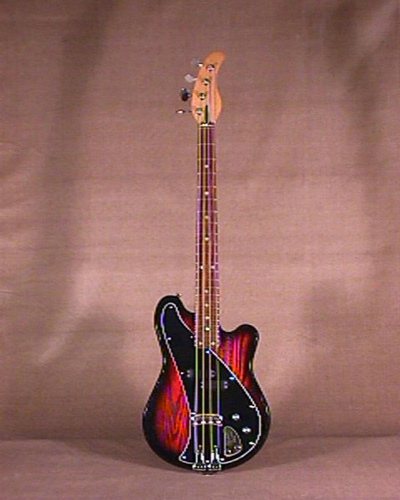
So, in designing the new generation SSB, I started from the ground up. I've kept the general styling of the original,
but I've made some significant changes to the geometry and construction. The new SSB is not a "reissue", but an all
new instrument. Because hardly anyone but me has ever seen or heard of the original SSB, I decided to stay with
the name SSB for my new version, rather than call it something like the SSB-2.
I stretched out the overall length by almost 3 inches, so it's only slightly smaller than a Fender-size bass. The
neck is 2" longer than the original, and only an inch shorter in length than a typical 34" scale bass neck. Because of
the short scale length, it has a full 24 frets in about the same length fingerboard that would usually have 20 frets.
All of the frets up to the 18th are clear of the body, so this bass is great for playing up high. I made the neck
quite thin, from front to back, but the width and string spacing are about like a P-Bass. Although I have large
hands and normally play a 35" scale AEB-2, I've found the SSB's neck and close fret spacing very comfortable and
easy to get used to.
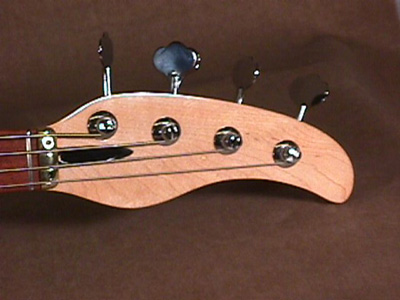
The original SSB's headstock was cut flat, Fender-style, and the shape is rather ugly. I started over on the new SSB,
tilting the headstock back and adding a thick volute on the back for stiffness. I came up with the cool
sweeping shape of the headstock to complement the style of the pickguard.
I also stretched out the whole body, lengthening the back end, and slightly extending the rounded horns. This improved
the visual proportions over the original, and makes it balance better. The body is all hollowed out inside with a series
of acoustic chambers to add sweetness and bloom to the tone of the high notes.
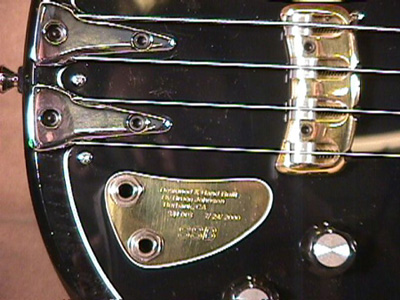
Because of the short scale length, the bridge ends up almost in the middle of the body. I mounted the tailpieces at the
very back edge of the body, leaving a long distance between them and the bridge. Although the
SSB is only 30 1/2" scale length, it uses standard 34" scale bass strings, giving you a wide variety of brands and
gauges to choose from. If you like, the SSB can be fitted with heavy gauge strings to increase the tension and
response. It also sounds great with flatwounds if you want a warm, smooth tone. As on the AEB-2 Scroll Bass, the
extra length behind the bridge allows the string to stretch more, so it can be plucked hard for a percussive attack
on the notes.